
Which Hybrid Should You Choose: Toyota Prius Prime or Honda Clarity?
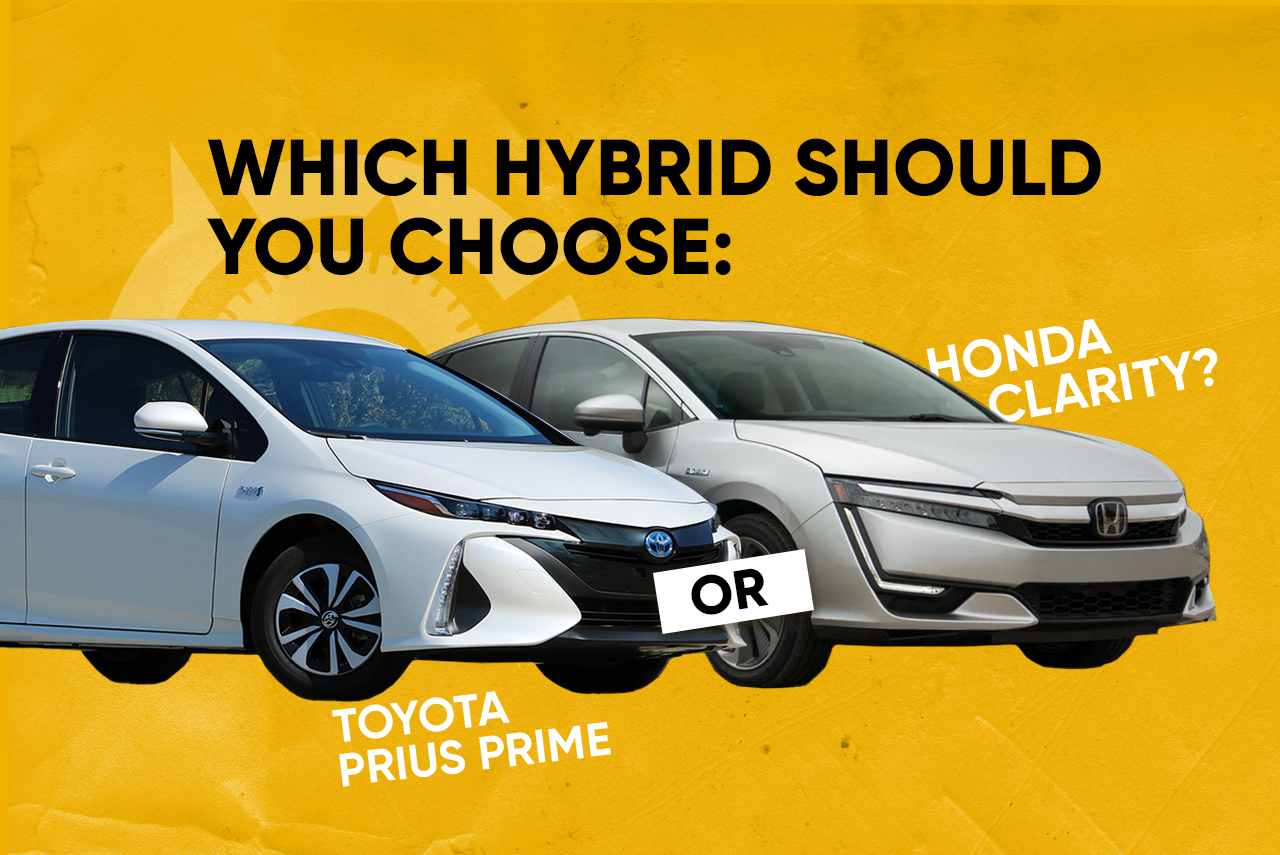
While most buyers have no issues when buying a regular car, it is not that simple with a used hybrid. Let us take two PHEVs as an example to analyze the nuances you might run into when purchasing a hybrid.
For comparison, let's take the five-year-old Toyota Prius Prime (2017–2022) and Honda Clarity (2018–2021). These hybrid models are direct competitors in both new and used markets.
Both cars are front-wheel drive, equipped with a 4-cylinder gasoline engine and additional electric motors, allowing for significant fuel savings. After daily overnight charging, the cars allow you to travel to and from work, as well as run small errands entirely on electric power.
Toyota Prius Prime (2017 – 2022)
-
Gasoline engine: 1.8L
-
Engine horse power: 121 hp.
-
Transmission: CVT
-
Drive: front
-
Number of seats: 4
-
Fuel consumption: 1.8L /100 km
-
Range on battery: 40 km
-
Editions available: 3
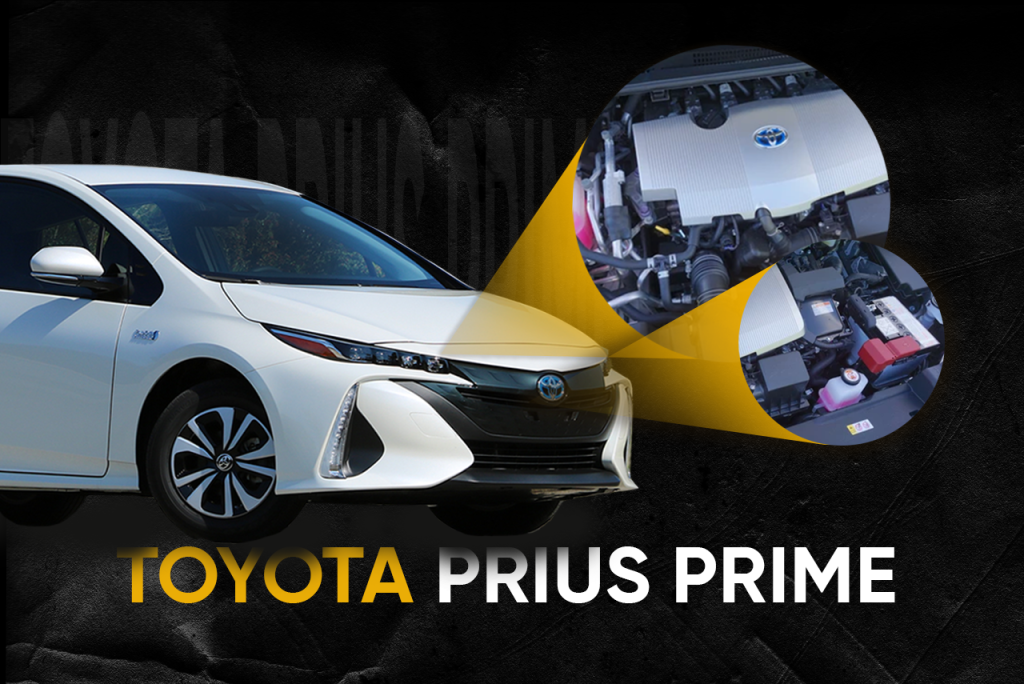
The Toyota Prius Prime, produced since the 2017 model year, can travel more than 1,000 km in the combined highway/city cycle with a full tank of fuel and a fully charged battery (charging the latter takes a little over two hours).
The car's hybrid transmission combines a 1.8-liter gasoline engine and two electric motors with a total of 121 horse power, paired with a simple CVT.
Keep in mind that the Prius Prime is the successor to the earlier PHEV (Plug-in Hybrid Electro Vehicle) Prius, which was based on the 2012 same name gasoline model. In the second generation of the hybrid – the one with the Prime prefix – Toyota updated the exterior and interior as well as battery engine.
This affected the car's range. While the first generation of the hybrid could travel only about 25 km using electric power (Toyota research has shown that 90% of the trips of city residents are exactly this long) at a speed of no more than 80 km/h, the figure for the 2nd Prius had this figure up by 35-40 km. At the same time, the speed of the car increased to 135 km/h.
Even when looking at the Prius Prime’s fuel consumption on gasoline alone, it is phenomenal at of only 4.4L/100 km!
Pros: outstanding efficiency, numerous safety features, futuristic look, high-quality interior.
Cons: poor dynamics, especially on the highway, bulky display of the infotainment system.
Honda Clarity (2018 – 2022)
-
Gasoline engine: 1.5 L
-
Engine horse power: 212 hp.
-
Transmission: CVT
-
Drive: front
-
Number of seats: 4
-
Fuel consumption: 2.1L/100 km
-
Range on battery: 75 km
-
Editions available: 2

The Honda Clarity debuted a year after the Prius Prime – in the 2018 model year - and is a larger and more powerful vehicle compared to the Toyota Prius. Although the Honda’s gasoline engine is more modest (1.5 liters compared to 1.8 liters in the Prime), the total power is almost twice as high - 212 hp.
The car is rather dynamic while being slightly less fuel efficient than its competitor – it takes 2.1L/100 km in mixed mode and 5.6L/100 km when driving on gasoline only. To be precise, in the consumption in the city is 1.9 liters and on the highway it goes up to 2.3L/100 km.
The engine and electric motor of the Honda Clarity, like the Prius, are combined with a conventional CVT. At the same time, the Clarity has a longer range than the Prime. A fully charged car battery (charging time from a 220-volt outlet is up to 3 hours) provides a range of more than 75 km on a single charge. That's more than the Toyota and most other PHEV models on the North American market. The only exception is the Chevrolet Volt hybrid with a range of 85 km.
The Clarity also wins over the Prius in size: it is a full-fledged mid-size sedan, while the Prime is considered a subcompact. Accordingly, there is more space in the former - both in the cabin and in the trunk.
Pros: fuel efficient engine, comfortable suspension, spacious interior and trunk, high-quality interior finishing.
Cons: mediocre maneuverability, uninformative steering, inconvenient and slow HondaLink infotainment system.
How to Test a PHEV: 5 Necessary Steps

Before you buy a used plug-in hybrid in the US, make sure you have the ability to do the following.
Step 1
• Undergo a pre-purchase inspection (PPI) of the vehicle at a service station (ideally a dealership) that has PHEV experts. Recently, a number of large automobile auctions have also been offering these checks, in particular the condition of the battery. It can cost anywhere from $150 to $250, but will help protect you from the larger costs of unplanned repairs in the future.
Step 2
• Check the service book (in both models it is integral with the user manual) to make sure that the car underwent regular maintenance. Delayed maintenance on a hybrid is fraught with negative consequences. For example, skipping the battery fan clean or replacement (carried out at least once every 30 thousand km) can lead to a short circuit in the battery and a high-voltage insulation breakdown check, followed by expensive repairs.
Step 3
• Assess the condition of the charging cable or travel charger supplied with the vehicle. Broken or torn insulation, damaged contacts, visible signs of burning or melting are signs that the cable needs to be replaced. Keep in mind that using damaged charging equipment can lead to failure of the car’s electronic systems.
• Check that the vehicle's charging port is working properly. Make sure it opens and closes all right, the cable fits into the slot with no issues, and all latches work properly.
• If possible, fully charge the battery using standard charging equipment and check for critical error messages on the instrument panel.
• In the future, do not buy cheap charging cables or travel chargers from unknown brands, as using low-quality (and often counterfeit) charging equipment may cause premature wear/melting of the battery terminals.
Step 4
• Check battery charge. Both Prius Prime and Honda Clarity, in addition to the high-voltage traction battery, are equipped with conventional 12-volt batteries to power on-board systems. Many owners complain that in hybrids these batteries do not last long. At the same time, if they run out of charge on a PHEV, it is fraught with more trouble than in a conventional gasoline car.
Step 5
• Inspect the brake calipers and rotors for rust, uneven wear or damage, and then test the brakes during a test drive. Excessive rust, scraping, squealing, or uneven brake performance are red flags. Remember - brakes in hybrids do not work as hard as in conventional cars and are more susceptible to corrosion. Proper maintenance and regular driving are the best solutions to prevent these issues.
Peculiarities of Inspecting a Toyota Prius Prime
In the US, there have been multiple recalls issued for the Prius Prime to repair latent defects, particularly in the electrical, braking and transmission systems. Many of them were eliminated through software updates instead of replacing hardware.
For this reason, it doesn’t hurt to find out all the possible bugs of a particular car by checking it using its VIN on the Toyota’s US website in the Safety Recalls & Service Campaigns section.
If the Prius Prime you've chosen to purchase has been regularly serviced by a dealer, there's likely nothing wrong with it.
Among other peculiarities of the Prius Prime is inspection of the windshield for cracks. A damaged windshield does not just look bad but can affect the operation of certain safety features that are literally crammed into this Toyota car.
Be sure to look in and under the trunk to see if there are any leaks. If you find moisture, it means there is a problem with the rear window or trunk seal.
Peculiarities of Inspecting a Honda Clarity

One of the most common problems with the Honda Clarity is the sudden and seemingly random activation of various warning lights/service messages on the instrument panel. This is the result of a software glitch that usually occurs with the cruise control failure or engine power loss issues.
This problem is prevented by installing a new 12-volt battery, and solved by rebooting the relevant systems and updating the “brain” of the car computer.
Pay close attention to the operation of the Clarity’s air conditioner during the test drive - cold air should flow without delay and with constant pressure.
Be sure to connect your Clarity to a Level 2 AC charger (up to 7 kW) and check if the model you chose is compatible. The fact is that owners of some cars claim that their Clarity does not charge or does not charge all the way when using this type of charger.
This ailment is also typical for cars made in the first year of production, 2018. It is also treated by updating the car’s software.
In addition, when inspecting the Clarity, you should check the condition of the batteries in the key fob. When they lose charge, they may cause the ignition switch to malfunction.
Sources: Driving.ca, Havecars.com


Help in the service