
Plug and Go: TOP 10 Hybrids with Longest Range

It’s still early to buy an electric car and probably too late to buy a car with internal combustion engine. The hybrid is currently the golden mean in terms of efficiency and practicality. Caranddriver and Columbus experts have selected top ten plug-in hybrids on the American market with focus on range.
Fully charged and with full tank of gas, these cars can travel much further without recharging or refueling than cars with a conventional internal combustion engine. One of the models included in the rankings covered 1,094 km with a cruising speed of about 120 km/h!
1. 759 km – Ford Escape Hybrid
-
Power plant: 2.5 L + 2 electric motors, 210 hp
-
Transmission: CVT
-
Drive: front
-
Range: 708 + 51 km
-
Fuel consumption: 5.5 - 6.2 L/100 km (highway - city)
-
Price new: $41,995

Since SUVs and crossovers are the most popular vehicles in the United States, most of the models featured in this top list are from this segment. And the compact SUV Ford Escape is its worthy representative.
It is available in two versions - as a conventional hybrid (FHEV) and as a plug-in hybrid (PHEV). The second has a declared range of 708 km on gasoline. The numbers could be even better, but it is limited by the car's relatively small fuel tank (54 liters). On electric power (from a 10.7 kWh battery), the car can go another 40 to 51 km.
It should be noted that for some buyers, the deal breaker for this model – which is great in many respects – is the lack of all-wheel drive, which is found in the ICE version of the Escape.
2. 791 km – Toyota RAV4 Prime
-
Power plant: 2.5 L + 2 electric motors, 302 hp
-
Transmission: CVT
-
Drive: full
-
Range: 740 + 51 km
-
Fuel consumption: 6.2 - 7.4 L/100 km (highway - city)
-
Price new: $45,040 – $48,910
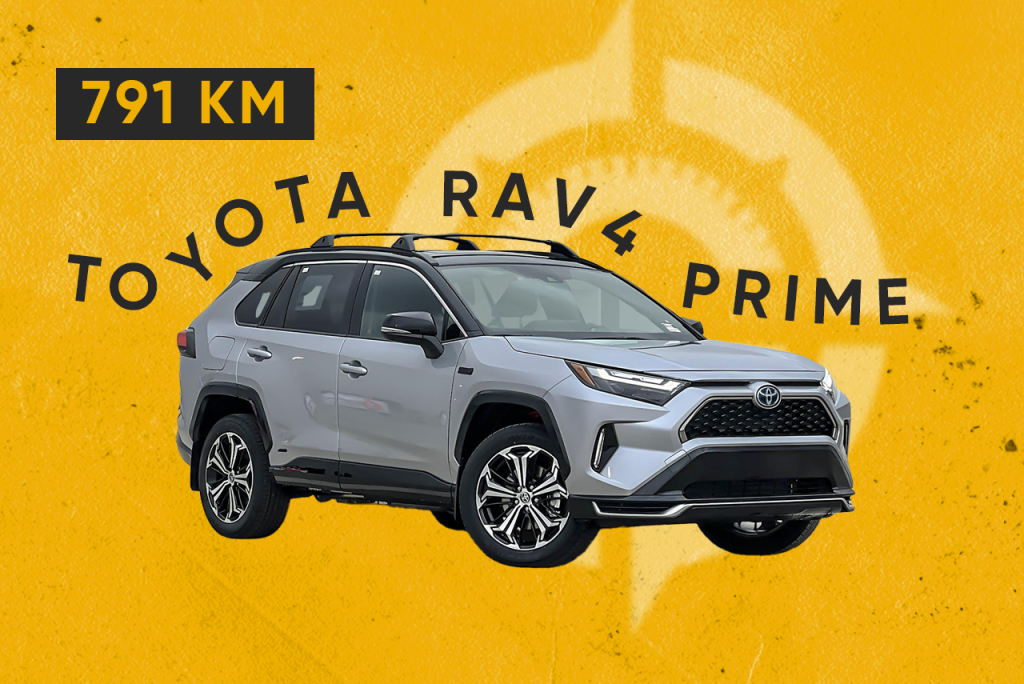
The hybrid Toyota RAV4 Prime is the fastest and most expensive model in the extensive RAV4 line: the vehicle goes from 0 to 100 km/h in just 5.4 seconds! At the same time, the car is quite efficient: the claimed range is 740 km on gasoline. The range provided by the 18.1 kWh battery is another 51 km bringing the total to 791 km which is a very good result.
The RAV4 Prime is powered by a 2.5-liter gasoline engine paired with a continuously variable transmission and two electric motors. Since one of the motors drives the rear axle, all-wheel drive is standard on all RAV4 Hybrid Prime trim, of which there are only two – the SE and XSE.
For 2023, Toyota updated the RAV4 Prime infotainment system to include the much needed features like Android Auto and Apple CarPlay support.
The RAV4 Prime is equipped with an extensive array of safety and driver assistance systems, which goes some way to justifying the car's hefty starting price.
3. 825 km – Toyota Prius Prime
-
Power plant: 2.0 L + 1 or 2 electric motors, 220 hp
-
Transmission: CVT
-
Drive: front/all-wheel drive
-
Range: 772+53 km
-
Fuel consumption: 5.1 - 5.6 L/100 km (highway - city)
-
New car price: $34,070 – $39,670
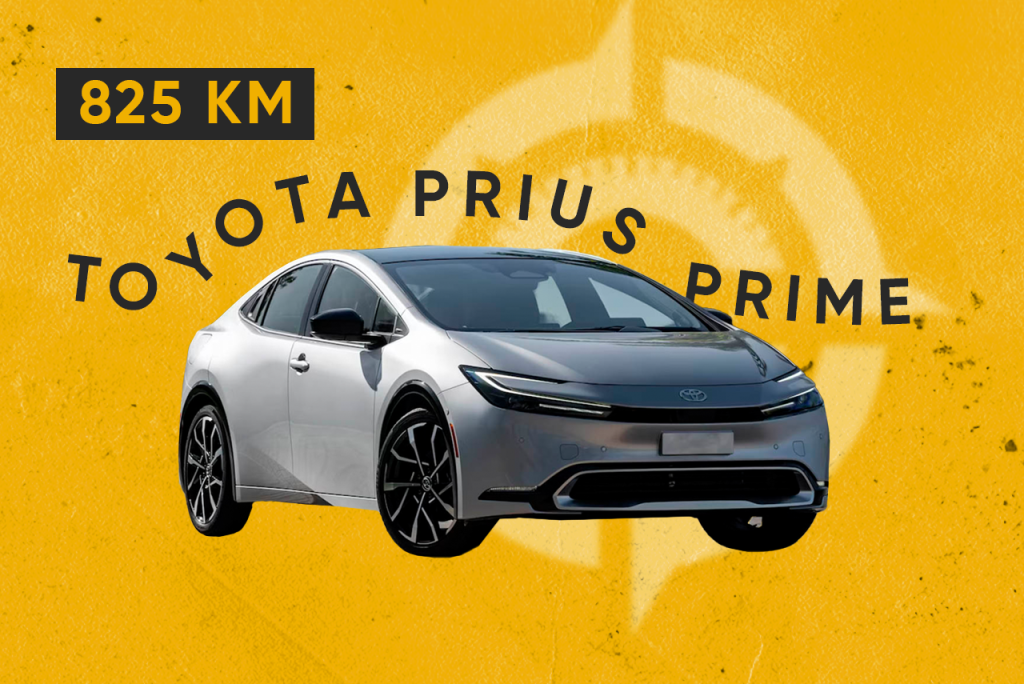
The Prius is now not only utilitarian, but also seriously cool - the 2023 redesign gives the hatchback a fresh and elegant look. In addition, the car's transmission has become more powerful.
Under the hood of the Prius Prime is a new power plant producing 220 hp, which is 99 hp more than the previous generation one. The dynamics of the Prius are now like those of a sports car – 6.6 seconds to get to 100 km/h. At the same time, fuel consumption is only 5.1 L/100 km when driving on the highway. Combined with the built-in 13.6 kWh battery, this provides an impressive (true) range of 825 km. Of these, the hybrid can travel 772 km on gasoline, and up to 53 km on electric power.
Interestingly, in the top configuration (there are three in total - SE, XSE and XSE Premium), the Prius Prime battery can be recharged from solar panels built into the roof. Although not while driving, but only when the car is parked.
In all three trim levels, the car is front-wheel drive, but all-wheel drive is available as an option; in this case, a second electric motor is installed on the rear axle.
4. 857 km – Lexus NX 450h+
-
Power plant: 2.5 L + 3 electric motors, 304 hp
-
Transmission: CVT
-
Drive: full
-
Range: 804+53 km
-
Fuel consumption: 6.2 - 7.1 L/100 km (highway - city)
-
Price new: $59,905 – $61,155
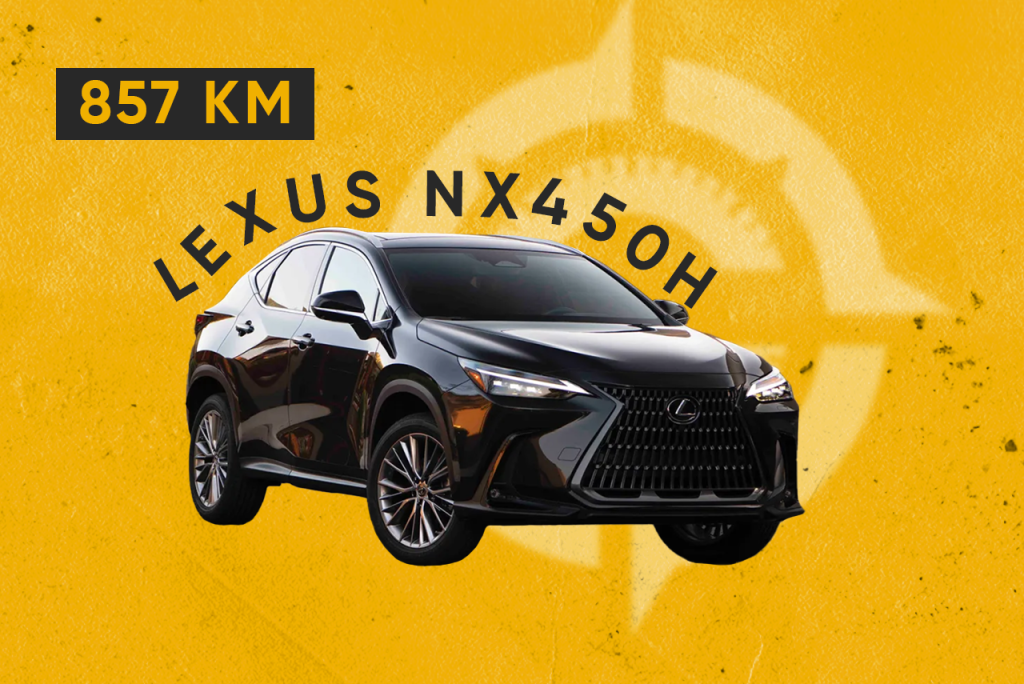
Arriving in 2022, the NX 450h+ is the thoroughbred brother of the RAV4 Prime. The hybrid power plant of the car is almost the same as that of its relative - 304 hp. (versus 302 hp for Toyota). However, during tests, the Lexus scores slightly better in fuel efficiency than the Prime, which means it also has a better overall range. On gasoline, the NX 450h+ can travel 804 km plus up to 53 km using its electric motor.
Lexus is all about comfort – the driver and front passenger will be happy with the comfortable seats ideal for long trips.
By the way, there is also a more premium version of the hybrid NX 450h+ – F Sport Handling. It has an adaptive suspension, front bucket seats and a sporty exterior and interior trim.
5. 862 km – Mazda CX-90 PHEV
-
Power plant: 2.5 L + electric motor, 323 hp
-
Transmission: Automatic
-
Drive: full
-
Range: 820 + 42 km
-
Fuel consumption: 8.7 - 9.8 L/100 km (highway - city)
-
Price new: $51,320
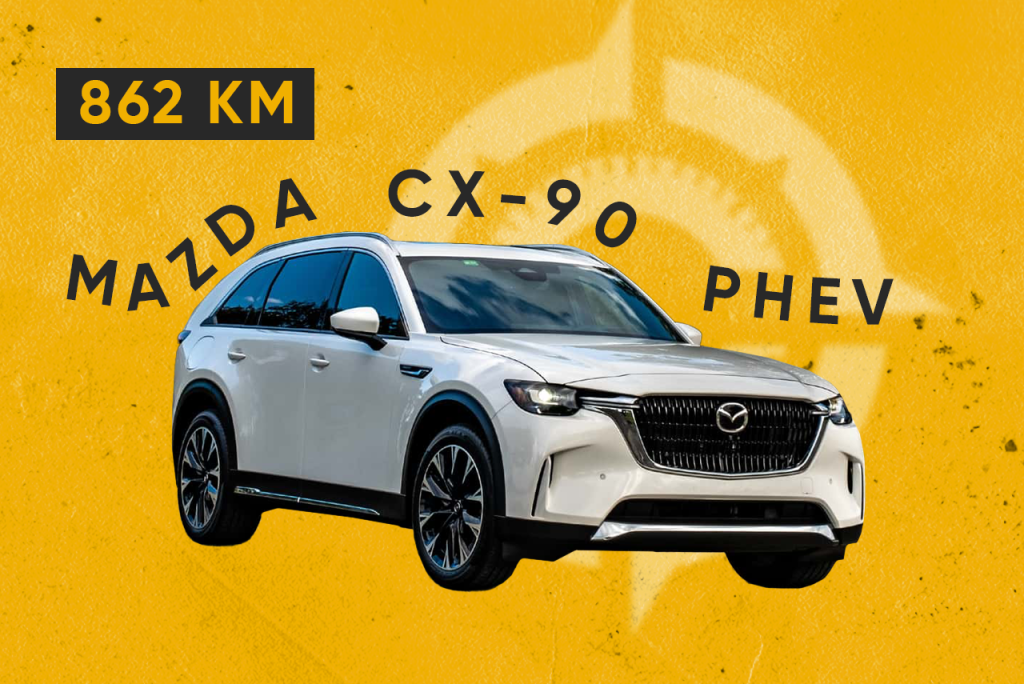
The Mazda CX-90, originally created with an eye on the US market, is a three-row premium SUV with 7-8 seats, which replaced the flagship CX-9 last year. Along with the 3.3-liter gasoline version, the new model is also available as a plug-in hybrid.
The latter is based on exactly the same power plant installed on the European CX-60 - a 2.5-liter gasoline engine plus one electric motor. Paired with an 8-speed automatic transmission and a 17.8 kWh battery, it provides the CX-90 PHEV with a good range including on electric power. Fuel consumption is somewhat high for a PHEV – up to 10 liters of fuel in city mode – but given the size and weight of the CX-90 we can look at it as acceptable.
All CX-90s come equipped with a rich suite of active safety and driver assistance systems called i-Activsense. European drivers will certainly appreciate the fact that the car can be charged from 20 to 80% in just 1.5 hours from a 220-volt outlet (the charge stats used here are provided for the car’s built-in charging equipment with different kWh values).
6. 883 kм – Volvo XC90 Recharge
-
Power plant: 2.0 L + electric motor, 455 hp
-
Transmission: Automatic
-
Drive: full
-
Range: 837 + 58 km
-
Fuel consumption: 8.1 - 8.4 L/100 km (highway - city)
-
Price new: $73,195 – $80,895
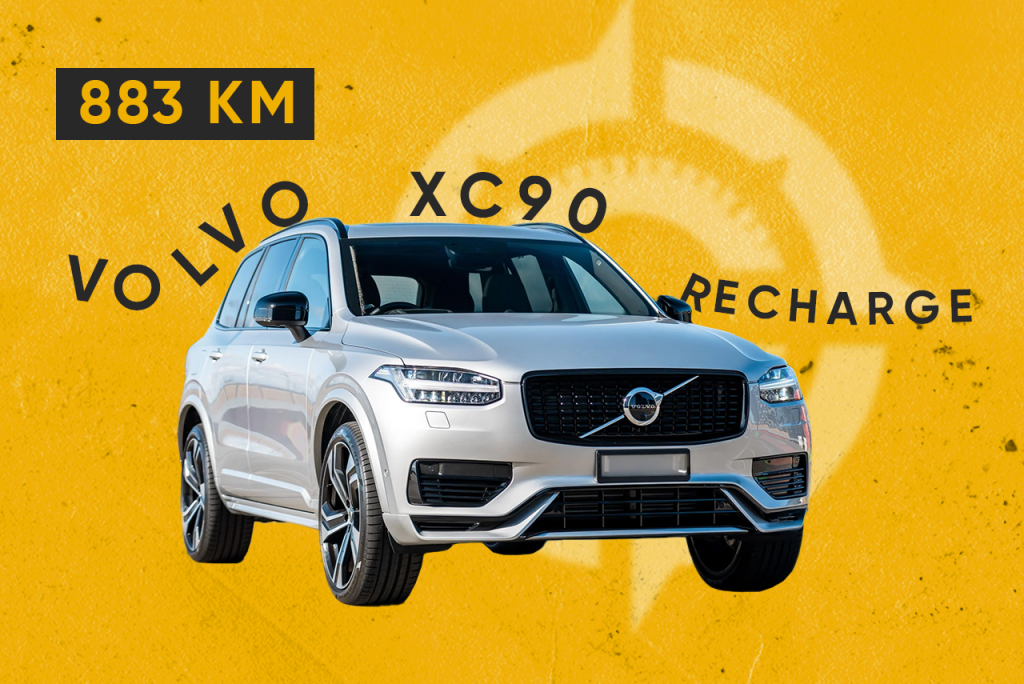
The stylish 7-seat mid-size SUV XC90 has been on the market for almost 10 years, but has had so many updates over the years that it is still up to date and popular.
The next upgrade was last year's plug-in hybrid transmission. Now the car uses a more powerful electric motor and an enhanced battery with a capacity of 14.9 kWh. Coupled with a 2-liter turbo engine and a fast 8-speed automatic transmission, this gives the large XC90 enviable dynamics (0 to 100 km/h in 4.5 seconds) and a good range, although not as impressive as that of smaller Volvo models.
The XC90 can travel up to 58 km on battery power; driving on gasoline allows the car to cover another 837 km. Interestingly, during the Сaranddriver.com test the XC90 Recharge traveled 78 km instead of 58 km, at an average speed of 120 km/h.
The hybrid is available in three different trim levels, same as its gasoline counterpart - Core, Plus and Ultimate. But they also have the word Recharge added to the name. The difference between the lowest and top trim is over $7,500, although there is nothing particularly revolutionary in the Ultimate edition: air suspension, bigger wheels (21 inches), ventilated front seats, a premium Harman Kardon audio system and other perks typical for an expensive car.
Charging the battery in any XC90 Recharge takes at least five hours (using a 220-V outlet).
7. 909 km – Chrysler Pacifica Hybrid
-
Power plant: 3.6 L + 2 electric motors, 260 hp.
-
Transmission: CVT
-
Drive: front
-
Range: 869 + 40 km
-
Fuel consumption: 7.8 - 8.1 l/100 km (highway - city)
-
Price new: $55,020 – $63,750

The Pacifica is unique in that it's the only minivan that available as a plug-in hybrid — at least until its direct competitor, the VW ID.Buzz, takes hold.
The Chrysler Pacifica Hybrid's power plant combines a fairly large 3.6-liter V6 gasoline engine with two electric motors. The fuel consumption of the power trio on the highway remains decent – about 7.8 L/100 km.
The hybrid has a large fuel tank of 62 liters (72 liters in the gasoline version), which provides a significant range of 837 km on gasoline. And you can drive another 40 km on electric power using a 16 kWh battery. In the highway test, the Pacifica Hybrid traveled a little less – 37 km – before the gas engine kicked in.
Among the pros of the car: sliding doors, standard for many minivans, giving instant access to the second and third rows of seats, and quick two-hour charging from a 220-volt outlet.
One of the significant cons is the lack of all-wheel drive in both existing Hybrid Select and Hybrid Pinnacle trim levels.
8. 940 km – Volvo V60 Recharge Polestar Engineered
-
Power plant: 2.0 L + electric motor, 455 hp
-
Transmission: Automatic
-
Drive: full
-
Range: 869 + 71 km
-
Fuel consumption: 6.9 - 7.6 l/100 km (highway - city)
-
Price new: $72,445

As a sports wagon with a powerful hybrid powertrain, the V60 is unique even for the American market. It's not cheap and produced in small numbers, but it offers a tempting combination of efficiency, power and style.
Since its 2020 introduction in the US, the V60 has only been sold in one Recharge T8 Polestar Engineered trim. The car is equipped with a turbocharged 2-liter engine and an electric motor with a total of 455 hp. This is enough to swoosh from 0 to 100 km/h in just 4.1 seconds. The subsequent dynamics is expectedly not as great – it will need 6 seconds to get from 100 to 160 km/h.
The V60 comes standard with all-wheel drive and an adjustable air suspension, so the owner can always tailor the car's road behavior to suit their preferences.
The station wagon's interior is spacious, the seats are comfortable, and the design is upscale. The premium finishing materials – metal, natural wood and supple leather – create a special elite vibe.
9. 951 km – Volvo XC60 Recharge
-
Power plant: 2.0 L + electric motor, 455 hp
-
Transmission: Automatic
-
Drive: full
-
Range: 901 + 50 km
-
Fuel consumption: 7.6 - 7.8 L/100 km (highway - city)
-
Price new: $59,195 – $76,545
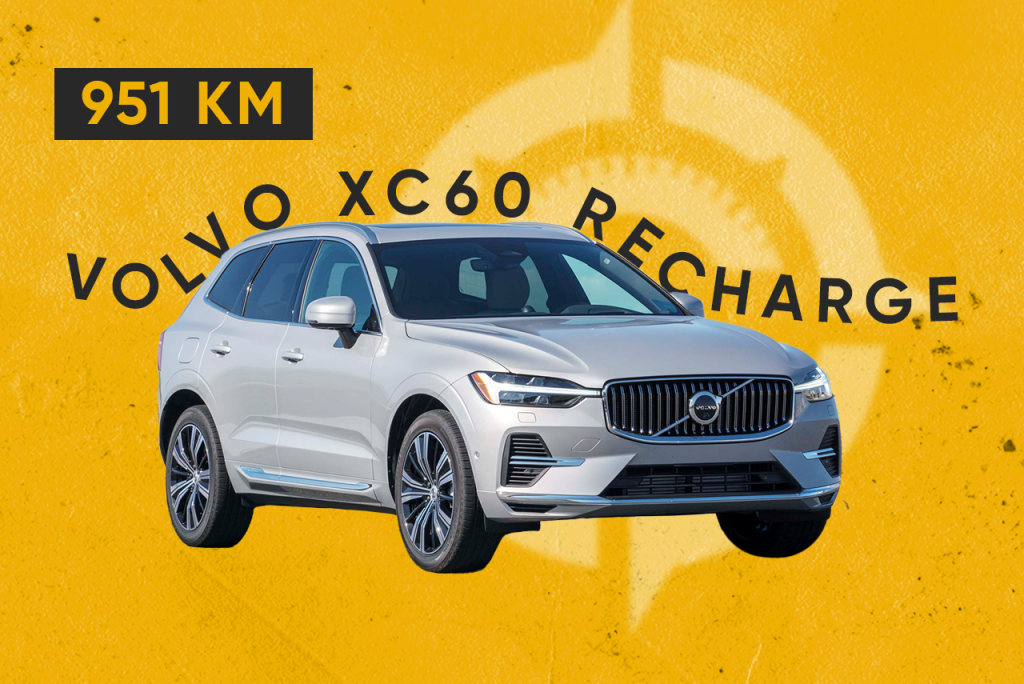
The compact luxury SUV XC60 seriously outperforms other Volvo hybrids in terms of range, although it has the same powertrain, producing 455 hp and delivering 0-to-100 km/h in 4.2 seconds.
And the car can travel an impressive 901 km on gasoline plus another 50 km on electric power from its 14.9 kWh battery. One of the main reasons for the impressive figures is the fuel tank’s significant volume – 71 liters.
In addition, the XC60 can use the electricity generated by the SUV's gasoline engine, similar to the how conventional ICE cars charge their battery.
There are 4 trim levels of this hybrid SUV available in the US – Recharge Core, Recharge Plus, Recharge Ultimate, Recharge Polestar Engineered. They differ from each other in the level of comfort and finishing, as well as the presence of air suspension in the two upper tier trim levels.
The main con of the XC60 is the same as that of its relatives - it takes 5 hours to charge the battery using a 220-V power outlet.
10. 1107 km – Mercedes-Benz S580e
Power plant: 3,0 L + electric motor, 510 hp
Transmission: Automatic
Drive: full
Range: 1,014 + 93 km
Fuel consumption: 6.5 - 7.4 L/100 km (highway - city)
Price new: $128,900

The leader of our hybrid race is a Mercedes flagship – the seventh generation S-Class sedan S580e, which went on sale in 2023. It stands head and shoulders above other PHEVs in many ways, as it not only offers an incredible range (1,014 km on gasoline and up to 93 km on electric power thanks to the super-capacity 22.7 kWh battery!), but it is also efficient. Fuel consumption on the highway is just 6.5 L/100 km/h, even if you decide to do 100km/h in 4.2 seconds, which you can.
Under the hood of this expensive hybrid – which costs twice as much as its closest competitor – is a 3-liter turbocharged 6-cylinder engine that, together with an electric motor, produces 510 hp.
The car comes standard with a built-in 9.6 kW charger, allowing you to charge the battery at home in just a few hours. If the owner of the S580e wants to charge the car faster, they will have to pay extra for a quick charger (60 kW) that will take it to 80% in just 20 minutes.
Sources: Сaranddriver.com, Cars.usnews.com


Help in the service